
EDITOR’S NOTE: The following is reprinted with permission from the North Dakota Farmers Union’s magazine, The Union Farmer. The magazine comes with an annual Farmers Union membership, or can be read on the organization’s website, NDFU.org.
SHEYENNE, N.D. — Nestled in the small town of Sheyenne is what appears to be an old Sinclair gas station — its exterior fully remodeled with Sinclair’s classic green and white. It even has the gas pumps to match, creating an image from Highway 281 that’s of a time gone by.
Inside the station, local farmer and rancher Joanna Larson bustles about in her vintage Farmers Union t-shirt, as she works to keep her new grocery store stocked. Her partner Ian Gilley — equally busy — is in and out with tasks. Visitors stop in from other towns. Locals come and go. Travelers park and take pictures of the station and its classic restoration, done by Devils Lake artist Gavin Brown.
“Locals love to bring their families in,” Joanna said. “We have a lot of motorcycles and classic cars that stop for photos.”
The real prize is inside. Welcome to Farmers Grocery.
A community that has been without a grocery store for more than 20 years suddenly has access to milk, bread, eggs and fresh produce in a convenient location.
“We’re two and a half months in, and I’m cautiously optimistic,” Joanna said. “It’s going well for us so far, but it’s a ton of work. That’s been a huge learning curve.”
Growing up in the community, Larson knew there was a need for access to grocery items. She even tried to fill that need with a small self-serve farm stand on Main Street that was completely on the honor system. The desire to solve that problem drove her to the decision that something more was needed. And with her and partner Ian Gilley both being engineers, solving problems comes naturally.
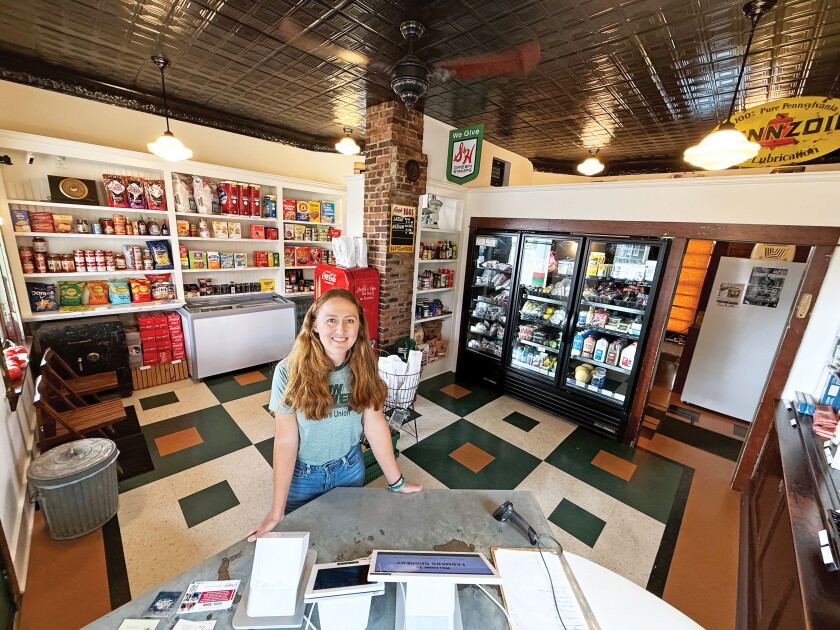
Joanna Larson poses in her store in Sheyenne, North Dakota.
Chris Aarhus, North Dakota Farmers Union
“When we lost our grocery store, there was a big hole for fresh fruit, vegetables, meat…” Joanna said. “Our community had tried to answer some of that with a farmers’ market and a community garden. … But it’s not just about fresh produce. It’s basic grocery items. You think about the livability of your community and what it means to be out of milk and have to get in your car and drive 10 miles. It’s about convenience, but also quality of life.”
She certainly wasn’t looking for more to put on her plate. The daughter of an agronomist (Peter) and Eddy County Extension agent and master gardener (Patti), Joanna grows certified organic vegetables on their family farm. Joanna and Ian also play a major role with her parents’ family farm that includes growing small grains and a livestock operation.
“There’s no way I could staff the store and (do all of that) without good help,” said Joanna. “I don’t do this by myself. The effort to make this store happen was dozens of people.”
The vegetables in the store are local, coming from Larson and other producers in the area.
“I have over two dozen local growers that have or will have something in the store,” she said.
Meat from nearby ranchers is processed at the co-op Bowdon Meat Processors, filling the store’s coolers. However, it takes help from Munich Grocery to fill the need of more basic items.
“We’re really fortunate to be working with them,” she said. “It’s how we’re able to have fresh fruit and conventional items on the shelves. If it wasn’t for them and their community-mindedness with how they operate that store, we wouldn’t be able to have this.”
In addition to Brown’s restoration of the building and local producers, Larson also needed help with some of the dollars involved. She partnered with the City of Sheyenne to apply for the Department of Commerce’s Rural Grocery Store Sustainability Grant, which awards up to $150,000 per applicant “to support the sustainability of rural grocery service, access to food, and/or development and expansion of food co-ops in rural areas.” Prairie Gates was one of 11 awardees out of 47 applications.
“It’s a very competitive grant and many communities across the state applied,” she said. “We were super fortunate that we got some of that money, so then we could really finish the store. I don’t know that we would be where we are without it.”
They’re working through supply chain issues, dealing with problems as they come up. For instance, it’s been a relatively dry year in North Dakota.
“We’ve had a hard time aggregating (vegetables) this year,” Ian said. “Last year, people’s gardens were more successful because the growing conditions for vegetables were a lot easier.”
Stepping into the store is like getting out of a time machine. The checkered vinyl flooring, the pressed-metal tile ceiling, the vintage Coca-Cola bottle machine — it’s an intentional reminder of a time when rural grocery stores were in their heyday. Shelving and cases were repurposed from the Bisbee drug store. The retro Pennzoil and Sinclair signs pay homage to its history as a filling station. Even the bathroom has a new paint job, covered in Sinclair green.
“I love being in the space,” Joanna said. “You’re in the work of doing it and figuring stuff out behind the scenes. Then to have it all come together, I just kind of sat here and took it all in.”
The aesthetics might be a flashback but make no mistake about the store’s capabilities — it’s a modern grocery store with new coolers, a membership system with a mobile app and 24-hour access, and a point-of-sale system that takes credit cards, Apple Pay and Google Pay.
The membership system provides easy access. Customers can pay $60 annually for 24-hour access seven days a week in which an app lets them through the back door and they check themselves out.
“One thing that took us by surprise is the amount of membership we have from neighboring communities,” she said. “Many of them come in here and wonder if they could make something work in their communities.”
In true small-town fashion, a clipboard sits on the checkout counter, where customers can write down product requests for the store. The latest version of the clipboard had eight to 10 items on it.
“The suggestion sheet speaks for itself,” she says with a laugh. “They want to do business here.”
The store is staffed for two-to-three hour increments six days a week, when anyone can shop and pay by cash, check or credit card. Otherwise, its members have full-time access, which is card-only in off hours.
“More and more people are utilizing the self-serve part of it,” she said. “We’ve seen an uptick in transitions when we’re not here. I’ve had a lot of people ask if we’re closing during the winter, and I say, “we’ll be here!”
It’s a project that was an immense undertaking, with passionate community-minded producers leading it.
“Ian and I took fairly big risks in doing this, especially in a small community where you want something to succeed so badly,” Joanna said. “We were careful about setting our expectations and looking at what would be feasible. So far, the community has exceeded those expectations. They’re really pushing our sales, and I’m really happy to see that.”