
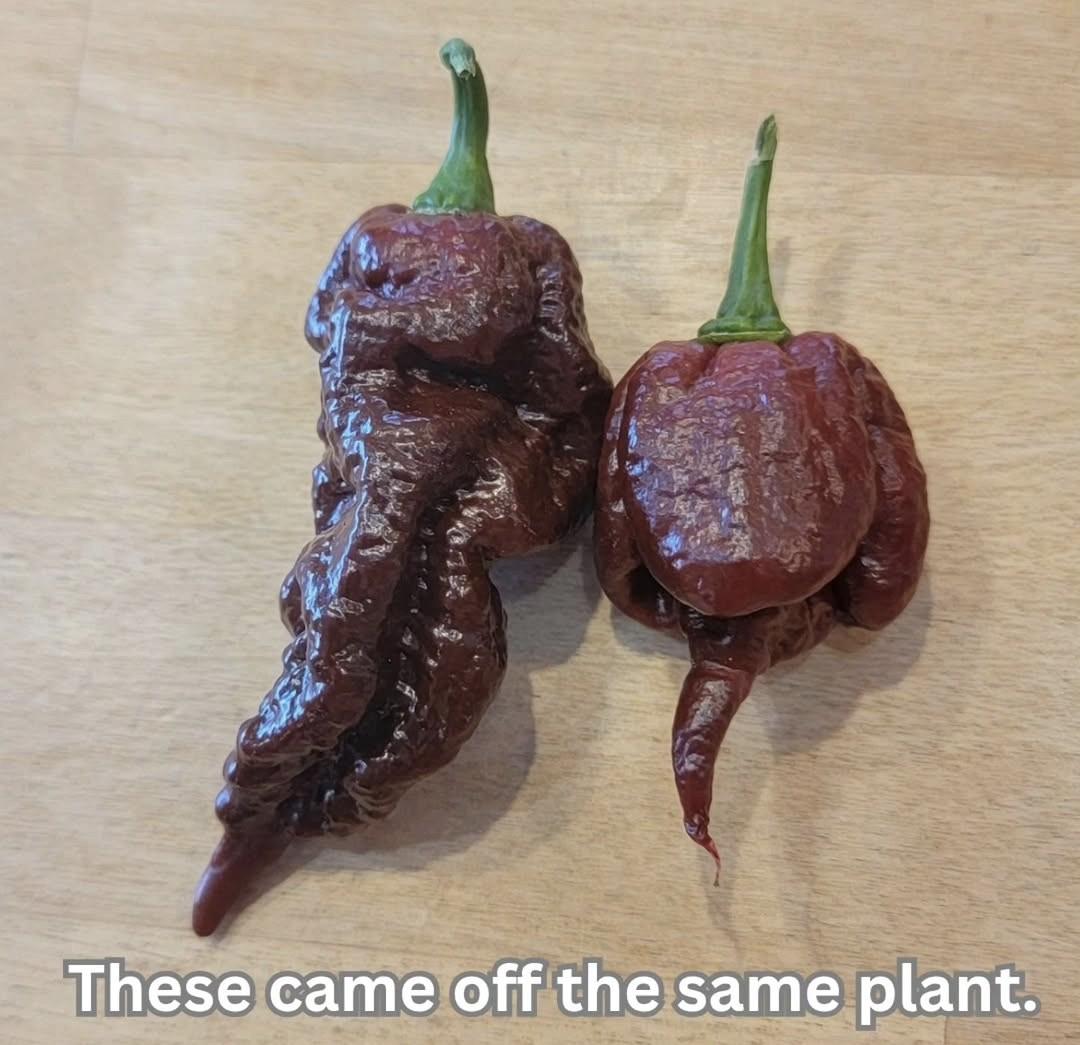
I see this question come up all the time — "my reaper pods look totally different from each other, did something cross-pollinate it?" — and I get it. When you've got one pod that's gnarly and bumpy and another that's smooth and elongated sitting on the same plant, your brain goes straight to "something pollinated this wrong."
But here's the thing. Cross-pollination physically cannot change the pod you're looking at this year. The fruit — the flesh, the shape, the color, the heat — that's all maternal tissue. It's the mother plant's genetics expressing themselves. Pollen only affects the embryo inside the seed. So even if a bee carried pollen from your neighbor's bell pepper onto your reaper flower, that reaper pod is still going to be a reaper. You'd only see the cross if you saved those seeds and grew them out next season.
So if it's not crossing, why do pods on the same plant look so different?
Temperature swings are the big one. Pods that set during a heat wave tend to come out shorter, sometimes deformed, and actually hotter. Pods that set during cooler stretches tend to elongate and mellow out. A Korean study growing the same variety at controlled temps found dramatic differences — 15°C produced long pods, 30°C produced short malformed ones, and capsaicin content went up linearly with temperature. Your plant didn't change. The weather did.
Light exposure matters more than people think. A pod tucked deep under the canopy versus one hanging out in full sun on the south side of the plant — they're going to look different. Sunscald is the extreme version. When a pod that was previously shaded gets suddenly exposed (wind blows the plant, you prune some leaves, the plant leans), you get those bleached, papery patches on the sun-facing side. One study found staked plants had 2% sunscald versus 17% on unstaked plants of the same variety. Same seeds, same soil, same water — just different light.
Watering inconsistency is a sneaky one. Drought stress produces smaller pods but they're more concentrated — higher capsaicin, more sugar, more vitamin C. Then you water heavily and the next flush of pods comes in bigger but milder. Two totally different looking and tasting pods, same plant, same genetics. Just different water availability during development.
And then there's blossom end rot, which isn't even a disease — it's a calcium delivery problem usually caused by inconsistent watering. The calcium is in the soil, but when you go dry-wet-dry-wet, the plant can't move it to the fruit tip fast enough. So some pods rot at the bottom and others are perfectly fine. Same plant, same day, different outcome.
Some varieties are just more variable than others. A lot of the superhots — Morugas, 7 Pots, some of the unstabilized crosses — were never bred for uniformity the way commercial bell peppers were. They carry more genetic diversity, so you naturally get more variation in pod shape even under identical conditions. Early season pods are almost always runts compared to mid-season pods too. That's not crossing, that's just the plant finding its stride.
Purple varieties are their own thing. If your plant carries the anthocyanin gene, pods will turn purple under UV and cold stress but stay green in warmer shaded conditions. Same plant, same branch sometimes — purple pod next to a green pod. It's conditional gene expression, not contamination.
The short version: if you're seeing different looking pods on the same plant, look at your environment before you blame the bees. Temperature, light, water, and nutrients explain 95% of within-plant variation. Cross-pollination is real, but it's a next-season problem, not a this-season one. The pod you're holding is the mother plant. Period.
Happy growing.
by Impossible_Celery_59