
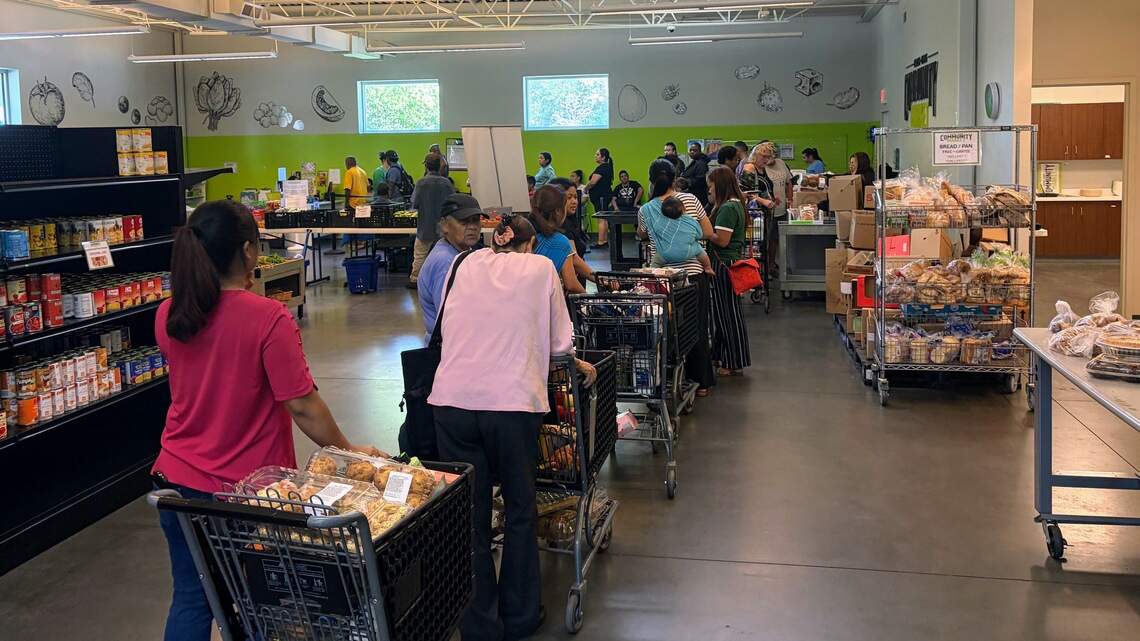
On a recent Monday afternoon at the Cross-Lines food pantry in Kansas City, Kansas, two dozen people, many with children, stood in a long line waiting for food.
It’s become a familiar scene across Kansas City, advocates said, as cuts to federal food assistance combine with rising grocery prices to create the highest levels of food insecurity in decades.
After checking in, people at Cross-Lines grab a shopping cart and walk through four aisles stocked with fresh produce, dairy, refrigerated meats, shelf-stable goods and hygiene products.
There are no price tags on the items. Instead, they are labeled with a point value. Shoppers receive a certain amount of points to spend when they check in.
One of the people waiting in line is Ron Crowley, a homeless man living in Johnson County, holding a shopping bag filled with fruit and hygiene products. He said places like Cross-Lines offer a rare lifeline amid a crushing environment of high prices and cut benefits.
“We’re blessed to have this,” he said. “We can’t even hardly go out and have a hamburger anymore, so we have to end up coming to places like this just to, you know, have some dinner.”
He gestured around the food bank at the children scattered throughout, many of them helping their parents select food or sitting in shopping carts.
“The kids, they need to come first,” he said.
As benefits decrease and prices increase, more people have been needing support, including many people who are turning to food pantries for the first time, said Kelly Gough Moran, director of development at Cross-Lines.
“We’ve seen a lot of new faces in our food programs and heard a lot about how difficult it is to really keep food on the table,” Gough Moran said. “We’re trying to make sure that we are serving as many people as we have the capacity to serve.”
The Kansas City area is seeing rising levels of food insecurity as high grocery prices combine with sweeping cuts to federal food assistance from President Donald Trump’s One Big Beautiful Bill Act.
Food insecurity across Kansas City is the highest it’s been in decades, said Elizabeth Keever, who works at Harvesters-The Community Food Network, a food bank serving more than 600 partner agencies across the region. One in five children in the Kansas City region lacks consistent access to enough food.
“I think a lot of people don’t truly understand how many people are experiencing hunger in the region, and I think it would come as a shock to most people in Kansas City,” Keever said.
Trump signed H.R. 1, also known as the One Big Beautiful Bill Act, into law on July 4, 2025. The law extended tax cuts from the first Trump administration and made deep cuts to federal safety-net programs like Medicaid and the Supplemental Nutrition Assistance Program, or SNAP, which provides monthly financial assistance for people with low incomes to buy food.
Those cuts are playing out at a time when high grocery prices are already squeezing family budgets.
Kansas City-area food pantries said they are struggling to keep up.
Multiple advocates cited one statistic to illustrate the impact of SNAP cuts in Kansas City: For every meal provided through a food pantry, SNAP provides nine.
“The charitable food system was never designed to make up for that longstanding and historically bipartisan program,” Keever said.

Workers help clients select groceries during Harvester’s monthly food distribution at Jackson County Public Health in Lee’s Summit on Wednesday, Nov. 19, 2025. The distribution, which drew a large crowd, is part of ongoing efforts to combat food insecurity in the community by providing residents with essential food items.
What cuts were made to SNAP?
Some of the biggest cuts to SNAP took effect soon after the bill’s passage.
The law raised the maximum age from 54 to 64 for those required to work, volunteer or participate in job training at least 80 hours a month to receive benefits.
Parents of children older than 14 are no longer exempt from work requirements. Blanket exemptions for groups such as veterans and people experiencing homelessness were also removed. Some immigrants who are legally living in the country, including asylum seekers, are no longer eligible.
Altogether, the cuts have resulted in more than 4.5 million people losing food assistance, including more than 30,000 people in Kansas and nearly 50,000 people in Missouri, according to state agencies. Tens of thousands of children across the two states have lost food assistance.

A client wheels a cart filled with food at the Redemptorist Center food pantry on Monday, Nov. 3, 2025, in Kansas City. Food pantries across the region are struggling to meet demand as many families face reduced or frozen SNAP benefits.
Biggest change is expected next year
More changes to SNAP are still to come.
In October, states will have to cover 75% of the cost of administering SNAP, instead of the traditional 50%.
The biggest change will land next year, when states with SNAP error rates of at least 6% must begin funding a percentage of the food benefits themselves.
Kansas and Missouri have both decreased their error rate in recent years but are still on track to owe the federal government millions to pay for SNAP.
The change has put pressure on state agencies tasked with administering SNAP to reduce payment errors, according to Haley Kottler, the senior campaign director at Kansas Appleseed.
These errors do not solely track fraud. They include any clerical errors, overpayments or underpayments.

Partially empty shelves line the Harvesters food bank warehouse Tuesday, Oct. 28, 2025, in Kansas City. The organization is working to provide food to local pantries amid the ongoing government shutdown affecting SNAP benefits.
‘Unnecessary hurdles’
Erin La Row, a spokesperson for Kansas Department of Children and Families, said Kansas has seen an unusually large drop in the number of people receiving SNAP benefits, likely due to “unnecessary hurdles created by recent federal and state legislation,” including increased paperwork requirements.
In Missouri, Baylee Watts, a spokesperson for the Missouri Department of Social Services, said nearly 70% of SNAP cases that closed during the past year were because the agency did not require information. Only 6% were due to incomes surpassing the eligibility limit.
Kottler said the reason why people no longer receive SNAP benefits matters. If someone gets a better job and no longer requires assistance, that is a good outcome of the program. But people losing food assistance because they couldn’t navigate new paperwork requirements is not a success, she said.
Kottler said one Kansas family was told it would no longer receive SNAP because they missed an interview they said they were not notified about. Eventually, they were told the agency was simply behind in processing applications. They did not receive SNAP benefits for July or August.
“The need does not disappear,” Kottler said. “Families cannot postpone eating until DCF catches up.”


