
Get Food & Dining Headlines
The Globe’s most recent food stories, delivered to your inbox every Wednesday.
 Jujubee, of “RuPaul’s Drag Race” fame, in a look inspired by an image of Buddha from her childhood living room.Eric Richard Magnussen
But before Inthyrath was Jujubee, he was a Lao kid coming of age in Lowell — which is how we find ourselves together at this restaurant table, as AAPI Heritage Month gives way to LGBTQ+ Pride month and Inthyrath’s identities intersect. On “Drag Race,” Jujubee celebrated her Lao heritage, whether wearing a look inspired by an image of Buddha from her childhood living room, or roasting another contestant in Lao during the show’s Reading Challenge. Now Inthyrath is sharing that heritage with me, through one of the closest-to-the-heart expressions of culture: food. I couldn’t have a lovelier guide, even if today he has ditched the gowns, wigs, and makeup for a light olive work jacket and button-down.
Food has always been important to Inthyrath. “My favorite thing to make is laab, and we’re definitely going to have some of that today,” he says, referring to the meaty salad that is a signature of the Lao table. “Sometimes Lao food isn’t the easiest thing to make because of the steps. But once you get the rhythm of it, you can master it in a very short period.”
For laab, he explains, you first grill and mince the meat, then mix it with the fermented fish sauce padaek. “It is like the most beautiful, salty, umami, bold, funky flavor you could ever taste. I don’t know how to really describe it, but I think I did a pretty good job there.” Also in the sauce: sugar, lime, bits of toasted rice.
“And, of course, I use MSG. I know some people don’t, but you know what they say: ‘MSG’ stands for ‘makes [expletive] good.’ But we can be rated G. It makes stuff good.” There are many other steps: toasting and grinding chiles, mixing the meat together with scallions, mint, and cilantro. Someday I’ll make it myself, but today I’m looking forward to Thoummaraj’s version.
 Laab at Laos Thai Kitchen, made with pork, mint, cilantro, scallions, and chiles. “I would dare to say that it’s our country’s and culture’s main dish,” Airline Inthyrath says.Suzanne Kreiter/Globe Staff
We talk while we wait. Inthyrath went to Lowell High, studied theater at UMass-Amherst, and got his start performing at clubs such as Divas in Northampton and Axis in Boston. Now he lives north of Boston, in a little pink house with a big garden.
Drag queen Jujubee tries Lao food in Lowell
Massachusetts drag queen Jujubee, also known as Airline taste tests food from Laos Thai kitchen in Lowell.
Inthyrath’s journey here wasn’t an easy one. His parents fled Laos as a result of what is often called the Secret War, during which the United States dropped more than 2 million tons of bombs on Laos between 1964 and 1973. They escaped to a refugee camp in Thailand by swimming across the Mekong River. In 1976, they immigrated to the US. Inthyrath was born in Brighton, then the family moved to Fresno, Calif. When he was 15, his father died of cancer. His mother, who was diagnosed with schizophrenia, moved him and his two younger sisters back east to Lowell, then left them. Separated from his sisters, Inthyrath went to live with extended family.
Food brought the household together. “I think this was the first time I felt part of this bigger family, and food was a huge deal for all of us. Everybody can cook in my family,” Inthyrath says. His father had loved to grill and made an expert version of laab. (The restaurant Lanxang Star in Dracut serves a version that tastes very similar, he says. “When I first had a bite of it, I teared up. I was like, oh my gosh, this tastes just like he made it. I need to go check the kitchen. Is he there?”) His aunt’s specialty is khao poon, a curry noodle dish people ask her to bring to every party.
Inthyrath is no exception: Like everyone in his family, he is a great cook. He and his sisters have reunited, and they get together often. “Every meeting that we have together, it centers around food. I’m always cooking, and they come to my house, and we finally have a place for each other,” he says. “I cook really great Laotian food. But I also make a mean sloppy Joe. Because I’m [Lao and American], and I love both. I love the complex flavors of Laotian food, but I will also jump on the bandwagon of a great American meatloaf. All that is comforting to me. It’s love in a different language.”
 Airline Inthyrath wraps food in a lettuce leaf with herbs. On the table (clockwise from center): a bowl of khao piak sen, chicken noodle soup; a woven basket called a thip khao, filled with sticky rice; sai koo, balls of tapioca dough filled with ground pork; laab; and thum mak houng, papaya salad. Suzanne Kreiter/Globe Staff
Lao food bears a resemblance to Thai food, but it is funkier, bolder, and spicier — a canvas for fermented flavors, chiles, and fresh, bright herbs, with sticky rice served in a woven basket called a thip khao.
The cuisine has a relatively low profile in the United States. But that’s not because it isn’t here.
“Every time I meet someone who says they don’t know about Lao food, they never had it before, I politely correct them,” says Saeng Douangdara, author of the new cookbook “The Lao Kitchen” (blurbed by Jujubee). “When the Lao refugees came en masse in 1975, a lot started opening Thai restaurants. That was what people wanted.
But “if you go to a lot of them, they’re actually Lao,” Douangdara explains. “They have a secret menu, the Lao secret menu. You’ve probably had a version [of Lao food], but those extra-funky, extra-spicy versions have been missing so long. They were eaten in the back but not put forward.”
This is changing. In Washington, D.C., chef Seng Luangrath has been shining a light on Lao cuisine through restaurants such as her acclaimed Thip Khao. Accolades from organizations including Michelin and the James Beard Foundation have brought attention and exposure to the food. Luangrath created the Lao Food Movement, an organization to help preserve the cuisine for future generations, and to support and mentor those who want to open their own loud and proud Lao restaurants.
Douangdara is also thinking of Lao food’s future. “My hope was essentially for the next generation of Lao people or people that are interested in Lao cuisine to be able to have a resource,” he says of his cookbook. “I’ve always sought out those resources, the moms and aunties, but sometimes they don’t want you in the kitchen. This book is a more inviting piece of work anyone can grab. It’s also about the Lao history and culture missing for so long within mainstream media.”
 Chef Veo Robert at a Phaeng & Phiu pop-up last year at Merai in Brookline. His pop-up showcases the cuisine of his native Laos. “To me, growing up, I never thought of Lao food as something that belongs in a professional kitchen,” he says. Danielle Parhizkaran/Globe Staff
Longtime Boston chef Veo Robert — who has worked at restaurants such as Radius, Menton, Myers + Chang, Bar Mezzana, and now Foxglove Terrace — emigrated from Laos as a teen. He got his start working at Thai Star, his aunt’s restaurant in Providence, where he grew up.
Last year, he launched Phaeng & Phiu, a Lao pop-up named after his parents. “To me, growing up, I never thought of Lao food as something that belongs in a professional kitchen,” he says. “The mission that’s going to give me energy and pride is always going back home and cooking my food.”
Many of his cousins no longer speak the language or prepare Lao food at home, he says. “The new generation of Laotian Americans is a little bit removed from our culture. It’s really scary for me that if my cousins or myself don’t continue to cook our food that it’s going to be lost. I don’t want to go to my family’s barbecue 10 years from now and be having just pizza and burgers.”
“We’re sharing everything”
This is where Jujubee comes in, bringing Lao representation to the wider world (“I’m probably the most well-known Laotian drag queen at the moment, you know, who is left-handed”) — and bringing me to Laos Thai Kitchen.
“Something that I really love about Lao food is you get this center dish, and then there’s always some sort of soup that comes with it,” he says. “And then there would also be a spicy dip, which we call jeow, and it would be made with fresh chiles and shallots, garlic, and you would season it again with fish sauce, MSG, and lime and sugar. You would taste it as you went, so you could perfect it to how you wanted it.”
Thank goodness the food is starting to arrive, because all this talk has made us ravenous.
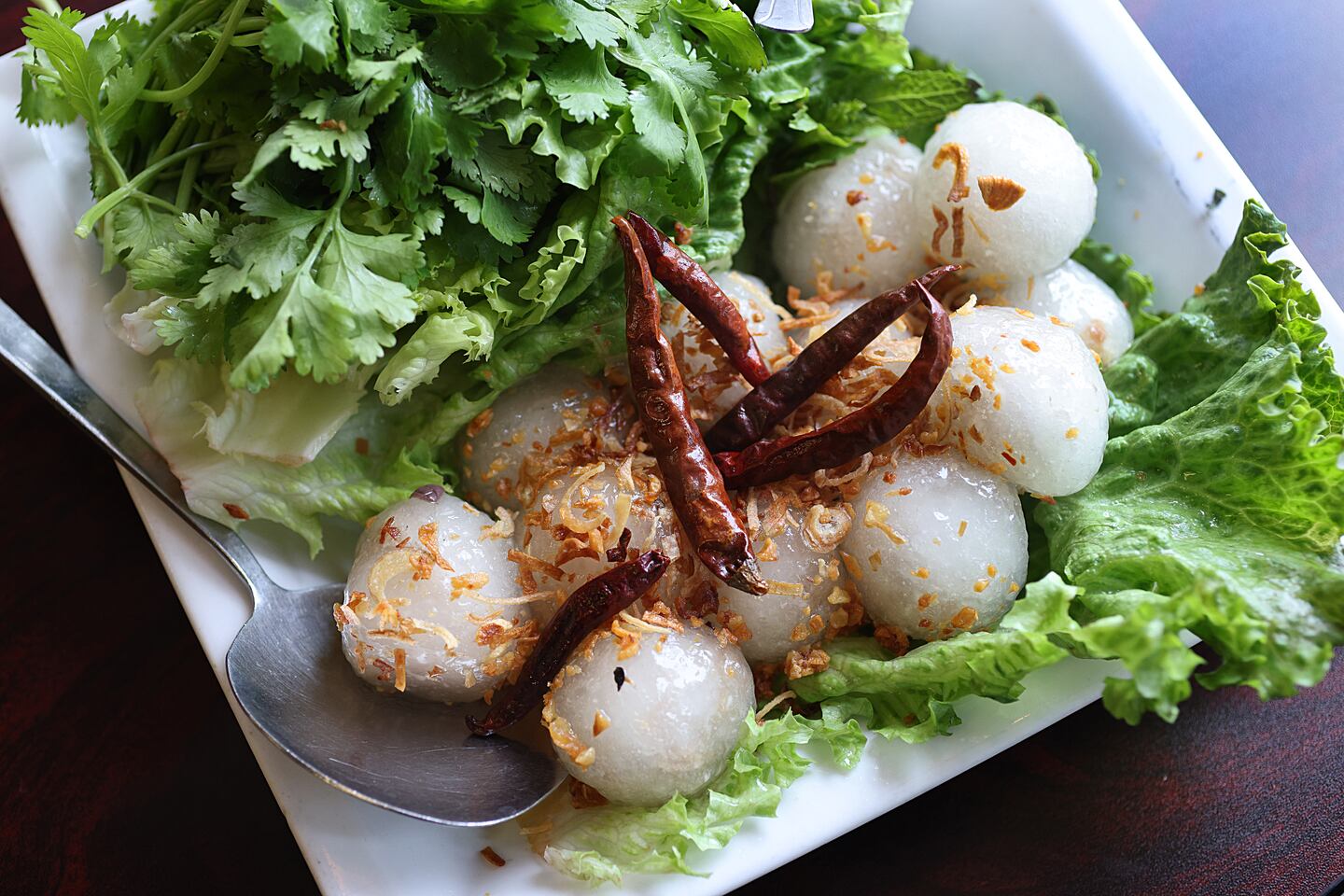 Sai koo, round dumplings made with tapioca and pork, are bouncy and chewy, the filling savory, the lettuce and herbs a counterpoint to the heat of the chiles.Suzanne Kreiter/Globe Staff
Thoummaraj has prepared sai koo, balls of tapioca dough filled with a mixture of ground pork, peanuts, and minced radish. They are topped with a sprinkle of fried shallots and whole dried chile peppers, served beside a pile of lettuce and fresh herbs, with a little dish of sweet tamarind sauce. We wrap the round dumplings in lettuce leaves with sprigs of cilantro and mint, drizzle on sauce, and bite in. I don’t think my mouth has ever been happier. The round dumplings are bouncy and chewy, the filling savory, the lettuce and herbs a bright, fresh counterpoint to the heat of the chiles and light sweetness of the dough. There’s so much texture and flavor, I could eat 10 billion of these and never get bored.
“Our dishes have this really healthy balance of salty, sweet, savory, sour,” Inthyrath says.
Finally it’s time: The laab has arrived. “I would dare to say that it’s our country’s and culture’s main dish,” Inthyrath says. “Although I think people would argue papaya salad would be that. It’s a toss-up.”
This version is made with pork, the bits of meat in almost equal proportion to mint, cilantro, and scallions strewn throughout. And chiles. Did I mention chiles? Inthyrath demonstrates how to eat it, taking a pinch of sticky rice from the thip kao on the table. “You just ball it up,” he says, then adds a pinch of the laab, “and eat it!”
 Lessons in how to eat laab: “You just ball it up,” Airline Inthyrath says of the sticky rice, then add a pinch of the laab, “and eat it!” Suzanne Kreiter/Globe Staff
We do. I taste lime, shallots, herbs, that beautiful, salty, umami, bold, funky padaek, exactly as described. We go back for more sticky rice, more laab. And again. “Eating Lao style is very communal,” Inthyrath says. “You don’t go to a restaurant and say, ‘I’m going to order this dish for myself.’ You order something and we’re sharing everything. And that’s what I love, because it’s about the community and it’s about the family.”
Khao piak sen, which Inthyrath describes as “our version of chicken noodle soup,” comes next.
The broth is so flavorful, so silky and chicken-y. The starch from the handmade tapioca noodles thickens it a little, he explains. Many surprises await in the depths of the bowl: “There’s braised chicken feet, there’s blood cake. These are things that I don’t eat, but I’ll eat it. These are things that my parents were like, ‘You should eat this,’ and I’m like hmmm. But I’ll eat it.” Me too. It’s chicken soup for the soul, for sure.
 Laos Thai Kitchen chef-owner Donna Thoummaraj talks about the feast she has prepared at her Lowell restaurant.Suzanne Kreiter/Globe Staff
Thum mak houng, Lao-style papaya salad, has everything: shredded green papaya, green beans, tomato, lime, fish sauce, shrimp paste. And chiles. Did I mention chiles? Here they come in fresh and dried form. Laos Thai Kitchen’s menu has a spiciness scale at the bottom, with heat levels as follows: one pepper (“coward”), two peppers (“wimpy”), three peppers (“careful”), four peppers (“Thai worthy”), five peppers (“adventuresome”), and six peppers (“Lao spicy”). Thoummaraj asked if I like spicy food, and I said yes. But when the bill comes, I note that our fiery feast has only been “careful.” I’m grateful the cook saved me from myself.
We are about to explode, but there’s one more dish, and I’m so glad we make room for it. It’s a salad called nam khao, a multitextured flavor extravaganza — a crushed-up ball of crispy rice, the fragments tangled with fermented pork sausage, strips of chewy pig skin, ground peanuts, herbs, lime, and fish sauce. And chiles, but you probably could have guessed that.
“That was so good,” I say. We thank Thoummaraj profusely. She is an incredible cook.
Inthyrath and I roll out to the car. I learned so much about Lao food today, and also Lao culture, thanks to my generous guide and host.
“Laotian people, we don’t ask for much,” Inthyrath says. “We just want to live a very loving, happy life, and our love language is food.”
Laos Thai Kitchen is at 478 Merrimack St., Lowell, 978-455-2727, Instagram @laosthaikitchen. For updates on Phaeng & Phiu pop-ups, follow @phaengandphiu on Instagram. “Stop! That! Train!” is in theaters Friday. To see Jujubee and Ginger Minj perform live in Provincetown in July, go to redroom.club.
Devra First can be reached at devra.first@globe.com. Follow her on Instagram @devra_first.


