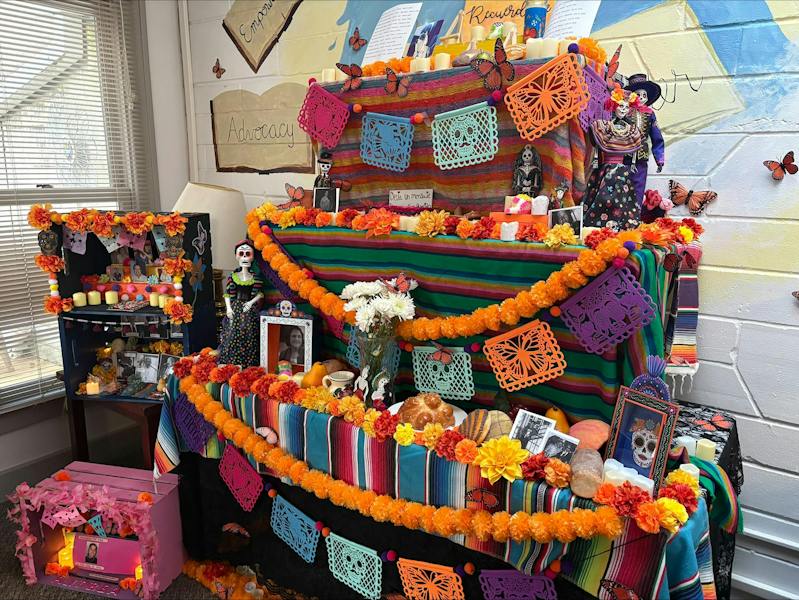
Photographs of loved ones lined colorful ofrendas as the smell of Mexican food wafted down the sidewalk in front of La Casa on Wednesday evening, bringing students, families and community members together to celebrate Día de los Muertos at Indiana University.
The Oct. 28 event was organized by La Casa/Latino Cultural Center and held at its house, as well as at the neighboring Canterbury House, First Nations Educational and Culture Center and the LGBTQ+ Culture Center, offering visitors a chance to try traditional foods, hands-on crafts and a see performance by Ballet Folklórico de IU.
La Casa hosts cultural events and educational programming that aims to bring together students and the wider Bloomington community. Attendees stopped by from 6-8 p.m., including IU students, families and young children wearing costumes, reflecting the gathering’s appeal across generations.
For Eunice Meza, a senior and social work intern at La Casa, the event was an opportunity to help students connect with Latino culture. Meza said this is her first year working at the center and that she was drawn to La Casa because she wanted to support students and contribute to a community she cares about.
Meza explained that ofrendas are a Mexican tradition arranged to honor deceased loved ones and can incorporate elements associated with nature. Food, whether real or artificial, can also be included on the altars, she said.
“Salt can represent air, candles represent fire and the fake food, or food that is placed on the altar, can represent earth and all of that,” Meza said.
Large, colorful ofrendas displayed photographs, food, flowers, beads and other items at the participating centers. Visitors could make tissue-paper flowers, get their faces painted on the Canterbury House porch and sample Mexican hot chocolate, pan de muerto, rice pudding, tacos and more.
Ballet Folklórico de IU performed outside La Casa at 6:30 p.m. Ballet Folklórico de IU celebrates Mexican culture through traditional folk dances from regions across Mexico, including Jalisco, Veracruz and Sinaloa, according to the group’s official website. Through performances and community engagement, the group aims to share Mexico’s cultural diversity with the IU community.
Meza said the event was open to anyone interested in learning about the culture and its traditions.
“Anybody that really wants to come and learn about part of the culture or see the different aspects of it is always welcome,” Meza said.
The celebration also reflected a longstanding relationship between La Casa and Canterbury House, an Episcopal campus ministry. Father Edward Bird IV, known as Father Ed, is a priest at Canterbury House and has served there since January 2021.
Canterbury House offered itself as a space for the celebration because the two centers are neighbors and have an ongoing relationship, Bird said.
“We always try to do things for our neighbors and La Casa,” Bird said.
Bird estimated that Canterbury House alone welcomed around 50 to 60 people during the first 45 minutes of the event..
The event has taken place since before the COVID-19 pandemic, Bird said. Its continued return reflects the collaboration among the campus communities involved in the celebration.
The partnership will extend beyond Wednesday evening; Bird said Canterbury House plans to collaborate with La Casa on the ofrendas for its upcoming All Saints’ Day service on Sunday. Bird regularly visits La Casa, and items from the Día de los Muertos celebration will be used in the altar for the service, he said.
The service will also offer another opportunity to remember loved ones. During its “Prayers of the People,” names written down by attendees at the Día de los Muertos event will be included in the service’s prayers, Bird said.
For some attendees, the event was also a way to maintain traditions rooted in their own family history. Lucia Conrad, an IU senior who attended the celebration, said she personally is not Latina, but she lived in Mexico with her family for a year, where they began the tradition of making ofrendas together.
“I always loved pan de muerto, it’s like my favorite Mexican food, and I love making it still every year,” Conrad said. “Normally, I will have a friend over and just make it. I’ve also made sugar skulls too, but they are kind of hard to get in the United States.”
Conrad noted that the folklórico performance was one of her favorite parts of the event. She described watching five performers dance while balancing lit candles in glass jars on their heads. The performance was a highlight of the evening for her, connecting the event’s cultural programming with traditions she already knew.
Sophomore Olivia Wilhjelm attended the event for her Spanish class and because of her interest in Spanish-speaking cultures, she said. Wilhjelm was particularly interested in Día de los Muertos and its traditions. She said she appreciated the holiday’s emphasis on celebration.
“I really like all the traditions that they have, and I like that instead of mourning the death of a family member, you can celebrate them,” she said.