Ingredients: Distilled Vinegar, Chilies (dried Calabrian, Sicilian and Tuscan Cayenne), Salt
Stuzzi Hot Sauce has an interesting (and globe-trotting) origin story. Founded by a quartet composed of Carla Rza Betts, a winemaker, Richard Betts, a winemaker and maker of tequila, Ethel Hoon, a Singaporean chef, and Jakob Zeller, a chef originally from South Tyrol (an extremely northern region of Italy in the Italian alps) the conception of the sauce was due party to happenstance. As the Betts were traveling through the Austrian alps they dined at a Southeast Asian / Alpine fusion restaurant run by Hoon and Zeller and after some discussion it was proposed they make a hot sauce together. Between the four of them they’d worked, traveled, and lived all around the world including opening a winery in Australia, working in Michelin star kitchens in Spain, living in Amsterdam, and opening restaurants in Austria and Italy. While Stuzzi was partially inspired by Hoon’s Singaporean chili paste the sauce truly came together when the four traveled through Italy together looking for inspiration and the perfect ingredients.
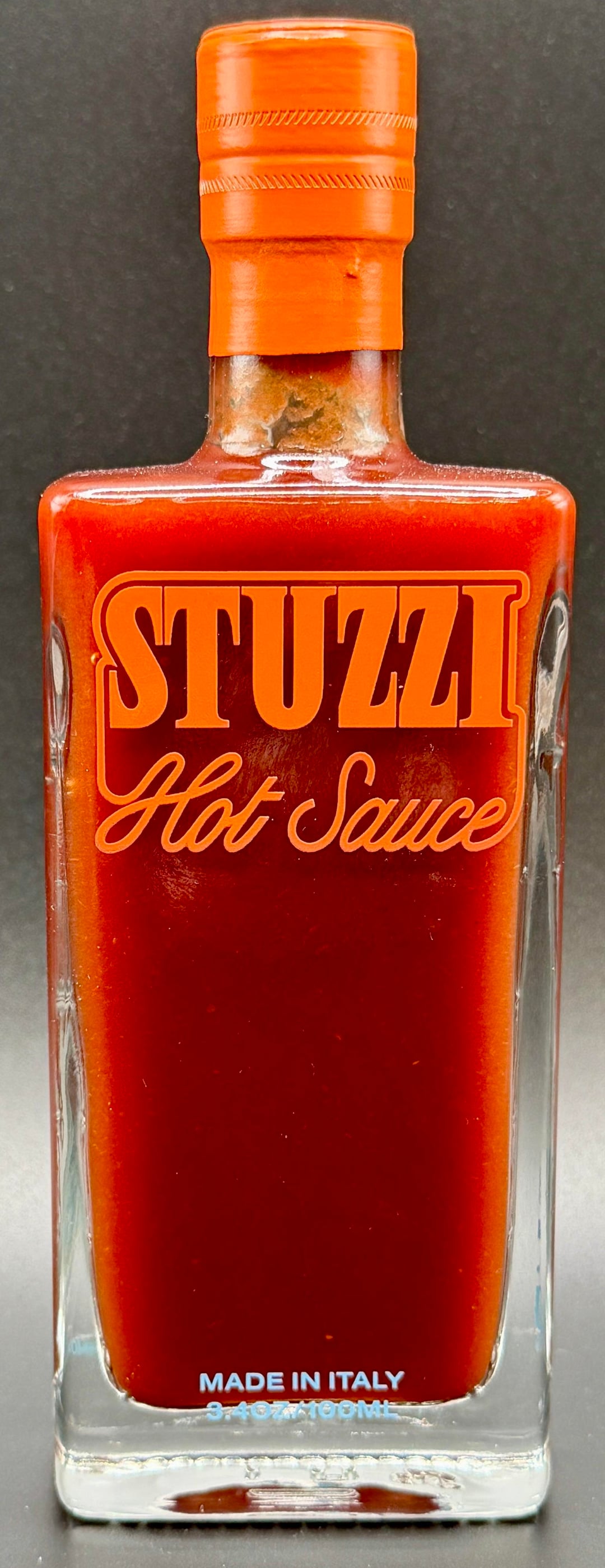
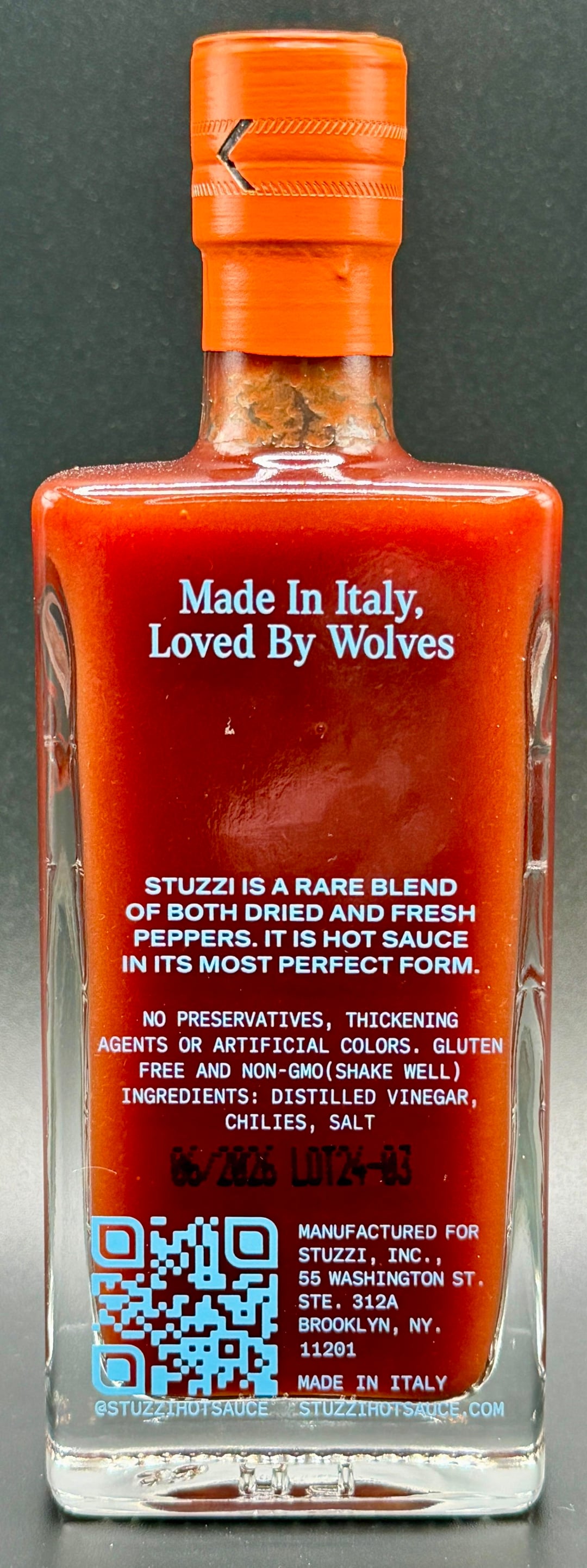
The name Stuzzi comes from the Italian stuzzicare which means “to tease” and embodies the concept of the sauce to have a medium heat but full flavor that can go with a wide variety of foods. On the back of the bottle are the words “Made in Italy, Loved by Wolves”. The sauce is made in the Italian Alps (though the peppers are all sourced from southern Italy) and the “Loved by wolves” is a reference to the legendary founding of Rome by Romulus and Remus who were weaned by a she-wolf. Speaking of the bottle, it’s a bit of a work of art, looking more like a high-end cologne bottle than a hot sauce bottle. The stopper is a bit odd – it’s a rubber stopper similar to what you’d see on old-school medicine bottles, but it works well.
The peppers used come from Calabria (the toe in Italy’s boot), Sicily (the island right in front of the toe), and Tuscany (what would be the front of the upper thigh on the boot). [Calabrian chiles](https://heckinhot.com/2025/05/20/loro-del-sud-crushed-calabrian-chili-peppers/) are rightfully famous. There are actually several types grown in the region of various levels of heat and shape, but all are members of Capsicum Annuum. It’s believed that the terroir of the region is what imparts the special flavor – the acidic soil, salty coastal breezes, hot days and cooler nights plus lots of sun all combine to make a perfect environment to grow peppers. Much like how San Marzano tomatoes are quite famous for their unique flavor grown in the Vesuvian soil so too are Calabrian chiles. In the case of Stuzzi the Calabrian chiles used are shade-dried to concentrate and preserve as much flavor as possible. In addition to those dried Calabrian chiles Stuzzi also uses fresh cayenne peppers from Sicily and Tuscany which are then fermented for six months. All of the chiles are milled to remove seeds and blended with organic distilled vinegar and Sicilian sea salt. All of the peppers used are organically grown and non-GMO. Stuzzi Hot Sauce has a thin consistency and a smooth texture. The aroma is complex with deep roasted notes as well as some of the funky aromas from the fermentation plus a strong vinegar presence.
Stuzzi starts off with a strong sour kick. It’s just on the right side of being harsh and blends the flavors of the vinegar and the lactic acid from the fermentation process. Underneath the vinegar however there’s a remarkably complex sauce here for such simple ingredients. When you dry chiles you fundamentally change the flavor. Much like [Fresno chiles](https://heckinhot.com/2025/05/07/high-mesa-chile-co-roasted-fresno-hot-sauce/) Calabrian chiles are known for having a flavor that blends the fruity and smoky and when dried the sugars are concentrated making them sweeter and giving the flavors similar to dried fruits while also accentuating that smoky character. The fermented Italian cayenne peppers have a flavor that’s similar to the Louisiana grown ones used in popular sauces such as [Louisiana and Crystal](https://heckinhot.com/2025/05/12/louisiana-style-hot-sauce-rankings-the-big-five/) but also seem to have a brighter fruitier note in this sauce. Something I found interesting is that there’s a suggestion of tomato and spices in this sauce that aren’t there in the ingredients. Something about the blend of the dried Calabrian chiles and the fermented cayennes creates a very fruity yet rich flavor, like a savory fruit salad involving raisins, tomatoes, berries, and celery, and tasting quite a bit better than that sounds. The heat level is above a standard Louisiana style sauce but still on the mild side. a quick bite that dissipates immediately.
Having tried one previous Italian hot sauce, the (in)famous [Casa Firelli](https://heckinhot.com/2024/08/08/casa-firelli-italian-hot-sauce/) (which I actually mostly like) I was hoping that like it this sauce would be a perfect blend with Italian food. I whipped up some spaghetti and meatballs and found that yes, this sauce is perfect with them. In fact, I liked this sauce with it more than I liked Casa Firelli. The lack of balsamic vinegar (a flavor I don’t often love) in this sauce really helped it blend better without adding any sweetness. Sometimes super-acidic hot sauces can have issues when combined with acidic foods like tomato sauce based pastas but that’s not at all the case here – somehow the tang of the sauce and the tang of the tomatoes blend together to form a whole greater than their individual parts. This sauce was equally at home with creamy pasta dishes. That acidity really shone through there, cutting through the cream and fat and lightening things up while also adding deep complex flavors which those sauces often lack. I also found this to be a perfect hot sauce for pizza. Again that’s an area where sometimes too much acid can be a detriment but the darker underlying flavors in this sauce from the dried Calabrian chiles really make it shine despite the intensely tangy nature. It’s even good with non-Italian food, I loved this as a breakfast sauce where the low heat and fruity flavors paired exceptionally well with eggs and bacon.
I’m happy to give Stuzzi Hot Sauce my enthusiastic recommendation. It’s delicious, deceptively complex, a chameleon in how it pairs well with a variety of foods and one of the absolute best I’ve tried when it comes to Italian pairings. This sauce is also all natural with no artificial preservatives, colors, flavors, or thickeners.

2 Comments
I don’t see a review
Bitter: 🟡🟡○○○
Salty: 🟡🟡🟡🟡○
Sour/Tangy:🟡🟡🟡🟡🟡
Sweet: 🟡🟡○○○
Umami: 🟡🟡○○○
Heat: 🟡🟡○○○○○○○○
Quick Flavor Notes: Tangy, Fruity, Rich
Recommended: Yes
Texture: Thin and smooth
Ingredients: Distilled Vinegar, Chilies (dried Calabrian, Sicilian and Tuscan Cayenne), Salt
Stuzzi Hot Sauce has an interesting (and globe-trotting) origin story. Founded by a quartet composed of Carla Rza Betts, a winemaker, Richard Betts, a winemaker and maker of tequila, Ethel Hoon, a Singaporean chef, and Jakob Zeller, a chef originally from South Tyrol (an extremely northern region of Italy in the Italian alps) the conception of the sauce was due party to happenstance. As the Betts were traveling through the Austrian alps they dined at a Southeast Asian / Alpine fusion restaurant run by Hoon and Zeller and after some discussion it was proposed they make a hot sauce together. Between the four of them they’d worked, traveled, and lived all around the world including opening a winery in Australia, working in Michelin star kitchens in Spain, living in Amsterdam, and opening restaurants in Austria and Italy. While Stuzzi was partially inspired by Hoon’s Singaporean chili paste the sauce truly came together when the four traveled through Italy together looking for inspiration and the perfect ingredients.
The name Stuzzi comes from the Italian stuzzicare which means “to tease” and embodies the concept of the sauce to have a medium heat but full flavor that can go with a wide variety of foods. On the back of the bottle are the words “Made in Italy, Loved by Wolves”. The sauce is made in the Italian Alps (though the peppers are all sourced from southern Italy) and the “Loved by wolves” is a reference to the legendary founding of Rome by Romulus and Remus who were weaned by a she-wolf. Speaking of the bottle, it’s a bit of a work of art, looking more like a high-end cologne bottle than a hot sauce bottle. The stopper is a bit odd – it’s a rubber stopper similar to what you’d see on old-school medicine bottles, but it works well.
The peppers used come from Calabria (the toe in Italy’s boot), Sicily (the island right in front of the toe), and Tuscany (what would be the front of the upper thigh on the boot). [Calabrian chiles](https://heckinhot.com/2025/05/20/loro-del-sud-crushed-calabrian-chili-peppers/) are rightfully famous. There are actually several types grown in the region of various levels of heat and shape, but all are members of Capsicum Annuum. It’s believed that the terroir of the region is what imparts the special flavor – the acidic soil, salty coastal breezes, hot days and cooler nights plus lots of sun all combine to make a perfect environment to grow peppers. Much like how San Marzano tomatoes are quite famous for their unique flavor grown in the Vesuvian soil so too are Calabrian chiles. In the case of Stuzzi the Calabrian chiles used are shade-dried to concentrate and preserve as much flavor as possible. In addition to those dried Calabrian chiles Stuzzi also uses fresh cayenne peppers from Sicily and Tuscany which are then fermented for six months. All of the chiles are milled to remove seeds and blended with organic distilled vinegar and Sicilian sea salt. All of the peppers used are organically grown and non-GMO. Stuzzi Hot Sauce has a thin consistency and a smooth texture. The aroma is complex with deep roasted notes as well as some of the funky aromas from the fermentation plus a strong vinegar presence.
Stuzzi starts off with a strong sour kick. It’s just on the right side of being harsh and blends the flavors of the vinegar and the lactic acid from the fermentation process. Underneath the vinegar however there’s a remarkably complex sauce here for such simple ingredients. When you dry chiles you fundamentally change the flavor. Much like [Fresno chiles](https://heckinhot.com/2025/05/07/high-mesa-chile-co-roasted-fresno-hot-sauce/) Calabrian chiles are known for having a flavor that blends the fruity and smoky and when dried the sugars are concentrated making them sweeter and giving the flavors similar to dried fruits while also accentuating that smoky character. The fermented Italian cayenne peppers have a flavor that’s similar to the Louisiana grown ones used in popular sauces such as [Louisiana and Crystal](https://heckinhot.com/2025/05/12/louisiana-style-hot-sauce-rankings-the-big-five/) but also seem to have a brighter fruitier note in this sauce. Something I found interesting is that there’s a suggestion of tomato and spices in this sauce that aren’t there in the ingredients. Something about the blend of the dried Calabrian chiles and the fermented cayennes creates a very fruity yet rich flavor, like a savory fruit salad involving raisins, tomatoes, berries, and celery, and tasting quite a bit better than that sounds. The heat level is above a standard Louisiana style sauce but still on the mild side. a quick bite that dissipates immediately.
Having tried one previous Italian hot sauce, the (in)famous [Casa Firelli](https://heckinhot.com/2024/08/08/casa-firelli-italian-hot-sauce/) (which I actually mostly like) I was hoping that like it this sauce would be a perfect blend with Italian food. I whipped up some spaghetti and meatballs and found that yes, this sauce is perfect with them. In fact, I liked this sauce with it more than I liked Casa Firelli. The lack of balsamic vinegar (a flavor I don’t often love) in this sauce really helped it blend better without adding any sweetness. Sometimes super-acidic hot sauces can have issues when combined with acidic foods like tomato sauce based pastas but that’s not at all the case here – somehow the tang of the sauce and the tang of the tomatoes blend together to form a whole greater than their individual parts. This sauce was equally at home with creamy pasta dishes. That acidity really shone through there, cutting through the cream and fat and lightening things up while also adding deep complex flavors which those sauces often lack. I also found this to be a perfect hot sauce for pizza. Again that’s an area where sometimes too much acid can be a detriment but the darker underlying flavors in this sauce from the dried Calabrian chiles really make it shine despite the intensely tangy nature. It’s even good with non-Italian food, I loved this as a breakfast sauce where the low heat and fruity flavors paired exceptionally well with eggs and bacon.
I’m happy to give Stuzzi Hot Sauce my enthusiastic recommendation. It’s delicious, deceptively complex, a chameleon in how it pairs well with a variety of foods and one of the absolute best I’ve tried when it comes to Italian pairings. This sauce is also all natural with no artificial preservatives, colors, flavors, or thickeners.