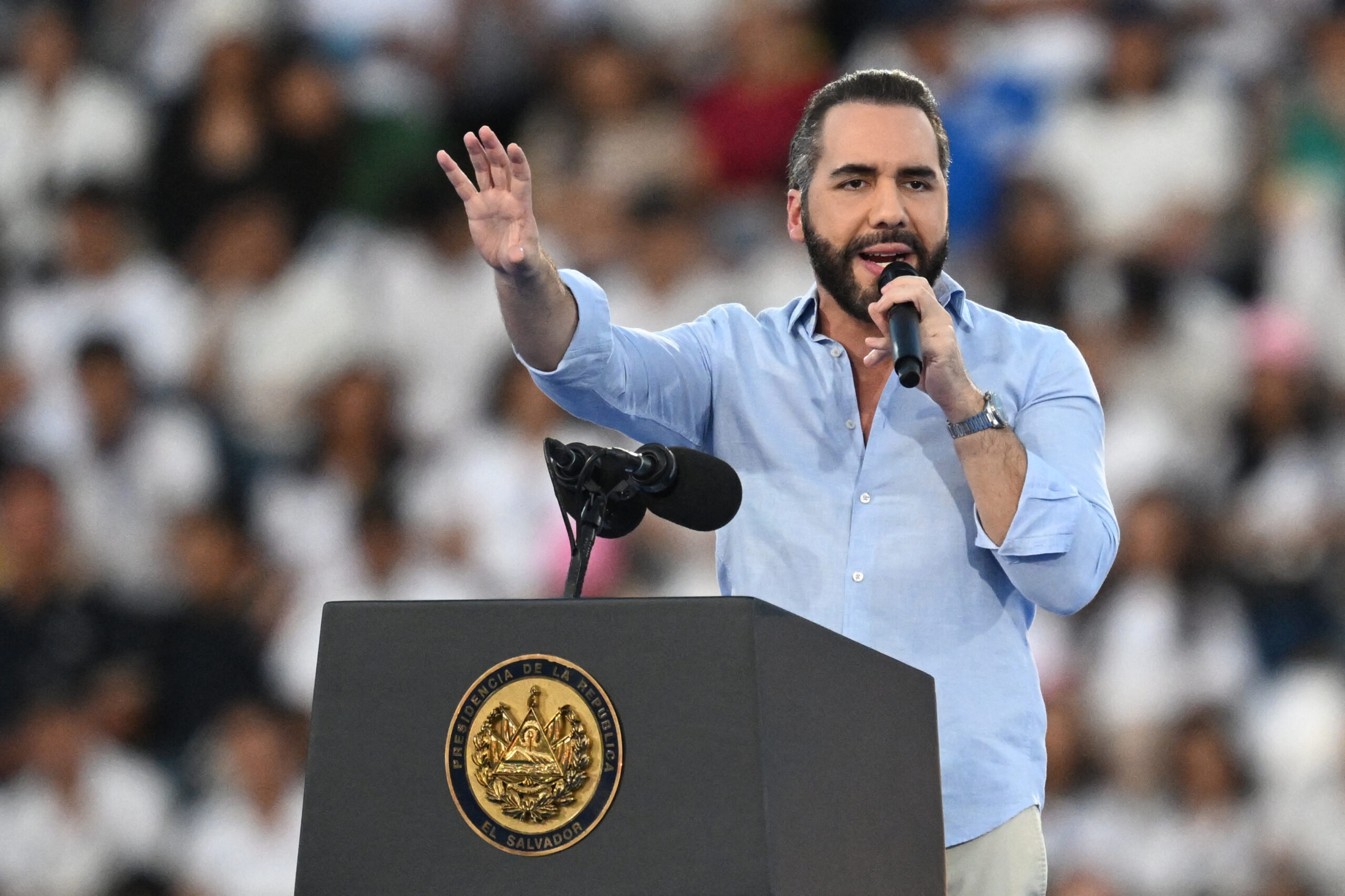
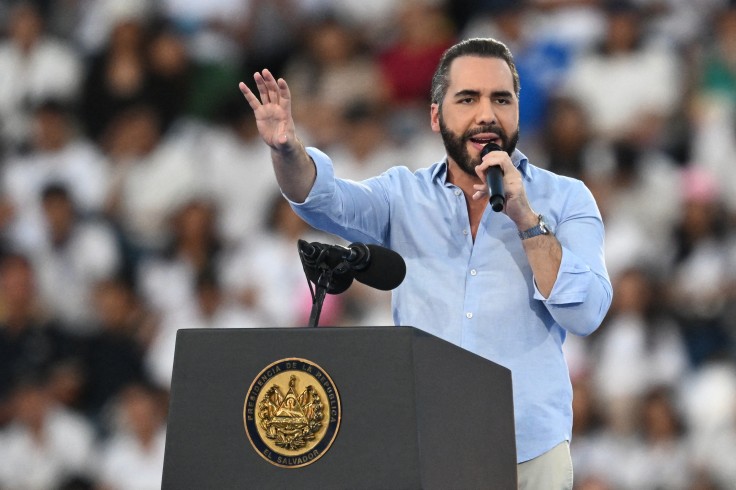
El Salvador’s President Nayib Bukele speaks during a meeting with more than 30,000 students at the Jorge “El Mágico” González Stadium in San Salvador on August 23, 2026.
Photo by MARVIN RECINOS / AFP via Getty Images
Four countries, four different security stories are colliding this September. El Salvador’s government is leaning harder than ever into its “safest country” narrative. Guatemala and Honduras, meanwhile, are watching numbers climb just as their own officials were touting improvement. Costa Rica sits somewhere in between: genuinely safer than a year ago, but nowhere close to declaring the crisis over.
El Salvador’s Streak Keeps Climbing — and the Count Just Got an Upgrade
According to the National Civil Police (PNC), El Salvador closed Friday, September 11 with zero homicides nationwide, pushing its 2026 tally to 218 days without a killing — a jump from the 213-day figure that circulated just five days earlier. Under the state of exception in place since March 2022, the country has now logged 1,206 zero-homicide days, and 1,320 since President Nayib Bukele took office in 2019.
The shift in who’s dying matters as much as how many. Data from the Attorney General’s Homicide Task Force, reported by Diario El Salvador, shows that of the 34 intentional homicides recorded between January and May, 27 cases — 79.4% — stemmed from social or family conflict rather than gang activity, with only seven tied to general crime. Gangs, once the dominant driver of the country’s homicide statistics, have nearly disappeared from the ledger. The country closed 2025 with a rate of 1.3 homicides per 100,000 residents, and a criminologist writing in Diario El Mundo projects 2026 could close below 1.0 for the first time on record.

Soldiers and police take position during an operation to arrest gang members in San Bartolo, Ilopango, El Salvador, on June 22, 2025. El Salvador’s President Nayib Bukele ordered the deployment of 2,000 military and police officers to a community in Ilopango, in the eastern periphery of San Salvador, after claiming that the gangs seek to “reorganize.”
Photo by Marvin RECINOS / AFP) (Photo by MARVIN RECINOS/AFP via Getty Images
Guatemala Breaks Its Own Momentum
Guatemala had spent the first half of 2026 outperforming 2025: the department of Guatemala alone recorded 601 homicides between January and June, 222 fewer than the same period a year earlier, per the Center for National Economic Research (CIEN). August erased that goodwill. The month closed with 318 killings — the highest monthly total in five years, above the 283 recorded in August 2025. Forensic data adds texture to the spike: the national forensic institute counted 147 violent deaths in just the first 14 days of August — an average of more than ten a day. Guatemala’s department, the capital especially, remained the epicenter, followed by Escuintla, Chiquimula, and Santa Rosa.
Honduras: A Decline That Comes With an Asterisk
Honduras’s Violence Observatory at the National Autonomous University (UNAH) counted 1,236 homicides in the first six months of 2026, which would project an annual rate near 24.6 per 100,000 people. Observatory director Migdonia Ayestas has been blunt about the trajectory, warning that “the reductions will really be minimal” against this projected rate.
There’s good reason for that caution. An investigation by El Heraldo found that Honduras’s Security Secretariat added at least 289 homicides to its official 2025 count — from 2,337 to 2,626 cases — between two public records requests filed two months apart. That upward revision to the comparison baseline artificially inflates whatever year-over-year drop the government claims for 2026. It’s not an isolated wrinkle, either: Honduras’s own cited 2025 homicide rate has shifted from 23.23 per 100,000 in January reporting to 26.6 by June, the kind of jump that only makes sense if the underlying case count changed too.
Costa Rica Improves, But the Alarm Hasn’t Gone Quiet
Costa Rica had logged 520 homicides through August 24, down from 570 over the same stretch of 2025, according to Judicial Investigation Organization (OIJ) figures cited by The Tico Times. The improvement isn’t uniform: Cartago climbed from 38 to 50 cases, Puntarenas from 76 to 84, and Limón from 118 to 120, even as the other four provinces posted declines. OIJ deputy director Michael Soto has linked part of that rebound to criminal groups reshuffling territory after their leaders’ arrests.
The OIJ projects the year will close between 693 and 766 homicides, well below the record set in 2023. That record itself is worth a correction: while some 2025 retrospectives cited 905 homicides for 2023, OIJ officials have repeatedly cited 907 as the official 2023 total in 2026 press briefings — the number this outlet is using going forward. Even the low end of the 2026 projection would still sit well above pre-2023 levels, which is why officials are framing this as improvement rather than crisis resolved.
What the Numbers Mean Together
Measured from mid-September, the gap between El Salvador and its neighbors is widening rather than closing. Guatemala and Honduras both show sharper deterioration than they did back in the first quarter, when each country was still touting year-over-year gains. Costa Rica is moving in the right direction, just not fast enough to close the distance with its northern neighbor. And the story isn’t purely a numbers game: Guatemala’s August forces a rethink of July’s optimism, Honduras’s near-300-case revision complicates any clean year-over-year read, and Costa Rica’s progress coexists with hot spots that refuse to cool in the Caribbean and Pacific corridors. For now, El Salvador is the only one of the four whose trend line shows no sign of reversing.
© {{Year}} Latin Times. All rights reserved. Do not reproduce without permission.