Reduces Costs, Streamlines Permits for Al Fresco Requirements, Establishes In-Person Office Hours, and Creates Fund for Operating Expense Relief
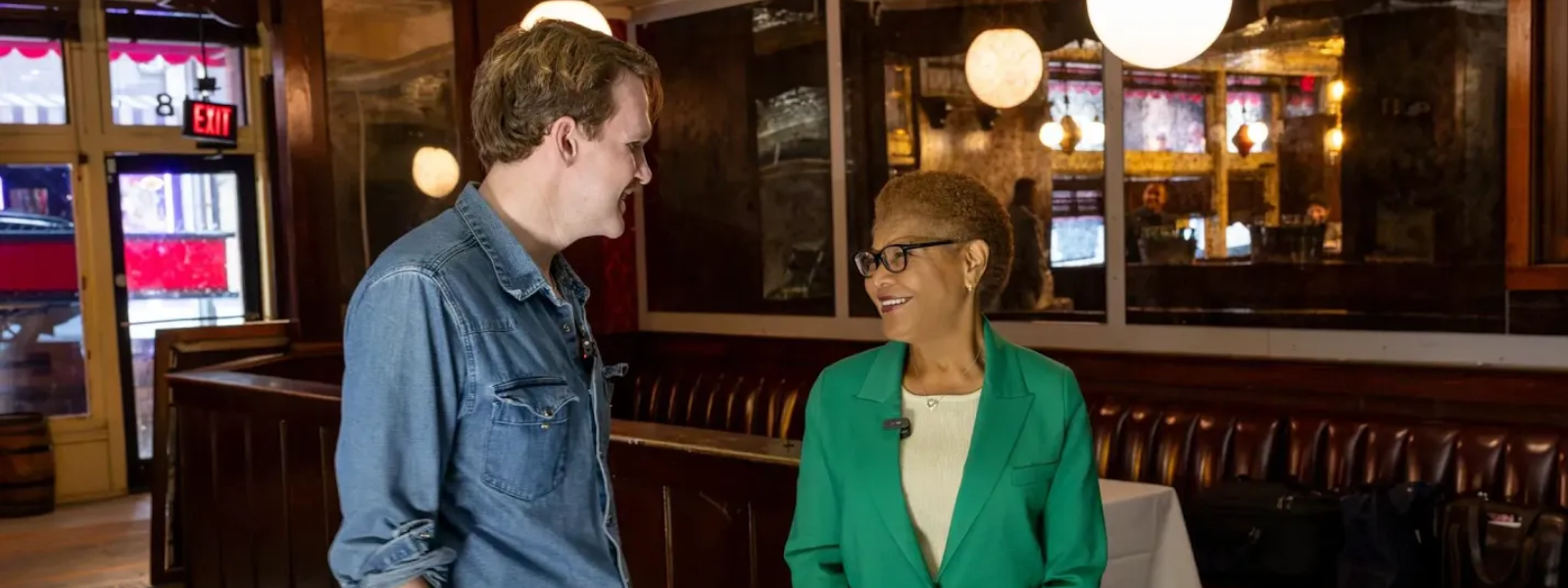
LOS ANGELES – Mayor Karen Bass signed a new executive directive to make it easier to open, operate and grow restaurants in Los Angeles. The directive reduces costs and streamlines permits by creating a self-certification program for Al Fresco dining, establishing in-person office hours at City BusinessSource Centers, and directing City departments to establish funding for a restaurant grant program. B-roll and photos of Mayor Bass’ recent visit to Cole’s French Dip are available here.
“When our restaurants succeed, our neighborhoods succeed. They create jobs, support families, and bring people together. I’m proud to sign this new executive directive to make it easier for restaurants to open, grow and succeed in Los Angeles,” said Mayor Bass. “Small businesses are the backbone of our local economy. That’s why I will continue to cut red tape, lower costs, and make City Hall work better for the business owners that keep Los Angeles moving. Because when we invest in our local businesses and the Angelenos behind them, we build a stronger city for everyone.”
The new directive calls for the following changes:
Simplify outdoor dining requirements: Establish an Al Fresco self-certification program allowing eligible restaurants to certify compliance with certain outdoor dining requirements, building on the permanent Al Fresco program established by Mayor Bass in 2023.
Make permitting easier to navigate: Establish regular, multilingual, in-person office hours at City BusinessSource Centers, bringing together staff from Building and Safety, City Planning, Transportation, the Bureau of Engineering and the Fire Department to help restaurant owners get answers and navigate City permits.
Help restaurants manage costs: Identify potential funding for a restaurant grant program that could help businesses cover rent, payroll, utilities, operating expenses and permit fees. City departments will also explore installment payments, deferrals and potential relief for Sewer Facility Fees.
Reduce delays and disruptions: Make previously approved outdoor dining plans available as templates, with owners’ consent; explore standardized plans for eligible locations; and improve coordination between street repaving projects and restaurants with outdoor dining areas.
Create more opportunities for local businesses: Review zoning and alcohol-permitting rules that can make it harder for restaurants to grow, explore simpler approval processes and develop a framework for entertainment zones that could allow outdoor alcohol consumption during designated events, bringing more activity and customers to neighborhood businesses.
Connect Angelenos to restaurant jobs: Help connect Los Angeles Community College District culinary arts graduates with restaurant industry jobs through the City’s WorkSource Centers.
Read the full Executive Directive here:
EXECUTIVE DIRECTIVE NO. 24
Issue Date: October 28, 2026
Subject:Streamlining Restaurant Permitting and Strengthening Our Small Businesses
Introduction
The restaurant industry is an essential part of the economic, cultural, and civic life of Los Angeles. Restaurants provide jobs, economic opportunity, serve as gathering places across our City, and contribute to the vitality of our neighborhoods. These vital businesses also reflect the extraordinary diversity of Angelenos and the cultures and traditions represented across Los Angeles.
Today, however, restaurants are facing significant challenges. Rising costs of food, labor, insurance, rent, utilities, and construction have placed increasing pressure on restaurant operators. Opening, expanding, and maintaining a restaurant can require navigating multiple City departments, applications, fees, inspections, and burdensome regulatory processes. For small business owners operating with limited time and resources, unnecessary complexity can result in significant delays and added costs.
The City has already taken important steps to support our restaurants and small businesses. We made the Al Fresco Outdoor Dining Program permanent following the Covid-19 pandemic, and expanded expedited permitting and concierge services for business owners, while providing free technical assistance, microloans, and fee relief to help reach businesses that need them most.
Now we must build on our efforts by reducing barriers and simplifying restaurant permitting requirements while maintaining appropriate standards for public health, safety, and accessibility. We must continue to create new opportunities for Angelenos by making capital assistance, technical assistance, and City services accessible to restaurants and small businesses throughout the City.
Therefore, to further bolster our City’s support of restaurants, small businesses, and the general welfare of the City’s economy, I hereby direct that:
I. Reducing Red Tape for Restaurants
A. Al Fresco Outdoor Dining Self-Certification Program
Within 30 days of this Directive, the Department of Building and Safety (LADBS), Bureau of Engineering (BOE), Department of Transportation (LADOT), and Bureau of Street Services (BSS) shall implement an Al Fresco Outdoor Dining Self-Certification Program.
The Al Fresco Outdoor Dining Self-Certification Program shall streamline permitting processes by allowing operators to self-certify regulatory compliance for Al Fresco installations including, but not be limited to, portable outdoor dining features such as tables and chairs, shade umbrellas, planters, and trash cans, as well as features that provide shade such as shade sails, pergolas, and trellises.
LADBS, BOE, LADOT, and BSS shall develop implementation guidelines for the Al Fresco Outdoor Dining Self-Certification Program. The implementation guidelines should address applicable procedures and requirements to enroll in the Self-Certification program, limitations on which types of Al Fresco installations are eligible for self-certification and those that may still require plan review, inspection procedures, auditing requirements, distancing from project elements (fire hydrants, ramps, fire exits, etc.), and accessibility review, as well any additional considerations necessary for implementation of the Self-Certification Program.
The Self-Certification Program shall be made available as part of the City’s review for all three types of Al Fresco outdoor dining programs, as follows:
Private property
On-Sidewalk
On-Street
For On-Sidewalk and On-Street outdoor dining, the implementation guidelines may address minimum distance requirements to public infrastructure, where applicable.
Within 30 days, the Department on Disability (DOD) shall report back to my Office with recommendations on how to best amplify existing resources to help businesses meet ADA requirements, in partnership with community organizations and the Mayor’s Office.
B. Supporting Al Fresco Operators in the Coastal Zone. Restaurants in the Coastal Zone are required to comply with an additional administrative hurdle: the Coastal Development Permit. These permits require months of coordination and review by the Department of City Planning (DCP), and subsequent consideration by the California Coastal Commission for operators located in the dual jurisdiction zone. The entire process may take 9-12 months or longer before permit issuance. To support Coastal operators through this lengthy process, my Office requests that:
Within 30 days of this directive, DCP, LADBS and BOE shall report back to my Office on a process to issue a conditional building permit for Al Fresco dining at the filing of a Coastal Development Permit for Coastal businesses. In preparing the report, DCP, LADBS, and BOE should consult with appropriate City agencies, including City Attorney and LADOT.
C. Sewer Facility Fee Payment Program
Within 30 days of this directive, LA Sanitation and the Office of Finance shall report back on establishing a new payment program to provide restaurants flexibility in their payment of sewer facility fees. The report should reference other municipalities for lessons learned on program structure, consider the project types that could be eligible for the program (all restaurants, only restaurants applying for Permanent Al Fresco Authorization, only restaurants transitioning from Temporary to Permanent Al Fresco Authorization, etc.) and the pros and cons of each. The report shall also address the feasibility of fee relief programs, and changes to existing procedures to provide more flexibility on the timing of payments (such as deferred or installment payment structures, and payment being allowed at different points in the permit approval process). The report shall provide an analysis of what changes may be made administratively or may require legislation to effectuate.
D. Mitigating Impacts to Dining from Street Repaving Projects
Proactive Interdepartmental Coordination
Within 30 days of this directive, the BOE and BSS in coordination with the LADOT shall develop guidelines and procedures relative to Al Fresco Outdoor Dining businesses that are or could be impacted by City improvement projects such as street repaving.
The guidelines and procedures shall address the following:
Procedures for the LADOT, BOE and BSS to regularly coordinate with one another regarding the locations of approved Al Fresco installations and future street repaving activities that may impact on-street dining establishments and applicants;
Flexibility and support that can be offered to restaurants that are in the process of applying for a new Al Fresco dining area and those with existing authorization;
Improved practices for notifying businesses along an impacted street; and
Regular recurring interdepartmental review of planned future repaving projects on streets with Al Fresco installations, and measures to improve coordination among relevant City agencies.
Like-for-Like Outdoor Dining Reinstallation
Restaurants that have removed or altered their authorized Al Fresco dining area due to street repaving shall be permitted to re-install their prior outdoor dining area as close to like-for-like as is practicable, unless precluded by critical safety standards. The guidelines and procedures developed pursuant to Subsection D.1.a, above, shall address permitting procedures and relevant considerations for like-for-like re-installation.
The guidelines and procedures developed pursuant to Subsection D.1.a, above, shall consider conditions where a like-for-like reinstallation would be safe and appropriate such as if street dimension changes were minimal or the number of lanes and speed limit were unchanged.
E. In-Person Restaurant Customer Support
Within 30 days of this directive, the following departments shall work with my Office to establish scheduled office hours across our City’s ten BusinessSource Centers:
The LADBS, DCP, LADOT, Los Angeles Fire Department (LAFD), BOE.
City staff should be equipped to support restaurants and businesses, particularly those whose primary language is not English.
In coordination with the Mayor’s Office, office hours will be offered on a recurring schedule for an identified time within regular working hours, and implemented in consideration of existing staffing needs and constraints. The frequency may be revised at any time in accordance with need and staffing availability.
II. Easier Plan Review
A. Within 30 days of this directive, the BOE and LADOT shall provide access to existing approved plans that can be used as templates and examples of compliant Al Fresco installations, where consented to by the owner of the plans. Such approved compliant plans and templates shall be shared as appropriate in a clear and useful manner with current and prospective applicants as a model catalogue or similar resource.
B. Furthermore, where consented to by the applicable design professional, an approved Al Fresco Outdoor Dining plan may be implemented as a Standard Plan.
C. Submitted Al Fresco Outdoor Dining Standard Plans on private property shall be reviewed under the existing LADBS Standard Program.
D. Public right-of-way standard plans may also be established where appropriate under street and sidewalk conditions such as sidewalk widths; proximity to trees, driveway or fire hydrant; street speed limit; street width; and number of street lanes, as determined by the BOE and LADOT.
III. Expanding Opportunities for Small Businesses
A. The Mayor’s Office Restaurant Grant Program
Direct the Community Investment Department (CID) to report back to my Office within 15 days to analyze and identify funding sources that could be used to create a Restaurant Grant Program, which could support costs such as operating expenses, permitting fees, rent, utilities, insurance, and employee payroll.
B. Reevaluating Overlay Zones that Impede Economic Development
Within 30 days of this directive, the DCP shall report to my Office with a review of specific plans, Community Plan Implementation Overlays, transit neighborhood plans, and other overlay zones that impose discretionary processes that can adversely affect restaurant and small business growth, including those that limit alcohol authorization. The report shall consider if current regulations and alcohol limitations in these overlays continue to meet community needs and citywide goals, and what pathways would be available if they were amended.
The report shall consider whether any related changes can be made administratively through tools such as departmental implementation memorandums, and where legislative action would be required to effectuate changed approaches.
C. Adapting Alcohol Authorization for a Modern Economy
Within 30 days of this directive, the DCP shall report on options and feasibility of offering a streamlined alcohol authorization process for businesses such as coffee shops, bookstores, and movie theaters that are not eligible for the City’s Restaurant Beverage Program (RBP). The report shall evaluate potential business types, including a growing new model of businesses that incorporate a mix of commercial uses, where streamlining would be appropriate and beneficial to the City’s economic prosperity. The report should summarize lessons learned from the RBP and how similar approaches could potentially be applied to other types of alcohol-serving businesses.
D. Modernizing Alcohol Authorization. Main Conditional Use Permits (MCUP) provide an umbrella entitlement with conditions for businesses in a given building or shared space. This is faster than the standard Conditional Use Permit process for individual establishments, but more arduous than what the RBP offers.
Within 30 days of this directive, the DCP shall report to my Office on whether and how businesses under a MCUP can pursue alcohol authorization under the RBP, where applicable. The report shall include relevant considerations on how the RBP program interacts with existing or proposed MCUPs, and recommendations for any improvements that could better support businesses and restaurants.
E. Restaurant Workforce Pipeline. Instruct the CID to establish a strategic partnership between its WorkSource Centers and LA Community College District Culinary Arts Programs. Through this partnership, the CID will support the placement of graduating culinary arts students into employment opportunities within the restaurant sector.
F. JEDI Zone. Within 30 days of this directive, the CID shall report back on how Jobs and Economic Development Incentive (JEDI) Zone funds could be used to expand the eligibility categories to better meet evolving needs of restaurants and small businesses.
IV. Activating the City’s Commercial Corridors
A. Citywide Entertainment Zones. The City of Los Angeles is the entertainment capital of the world. The City should leverage the authority granted by the State to thoughtfully designate Entertainment Zones across the city to promote economic development through our small businesses, cultural vibrancy, nightlife and creative communities.
Within 45 days of this directive, the DCP in coordination with the LADBS, LADOT, BSS, BOE, LAPD, the City Attorney and the State of California Department of Alcoholic Beverage Control shall develop and report on a Citywide Entertainment Zone Policy. The report shall provide:
Recommendations for how special event permitting can be handled with flexibility in these areas, especially for a special event related to a Major Event or culturally focused programming designed in partnership with a local community-based organization.
Recommendations for how alcohol authorization may be streamlined in these areas for live entertainment such as music venues, performance venues, and live theater.
Community outreach requirements informed by Senate Bill 969.
Guidelines to inform the locations and areas in which Entertainment Zones are proposed and implemented. Factors that inform their proposed locations may include surrounding zoning, existing uses, transit proximity, and commercial density.
Executed on this 28th day of October, 2026
KAREN BASS
Mayor