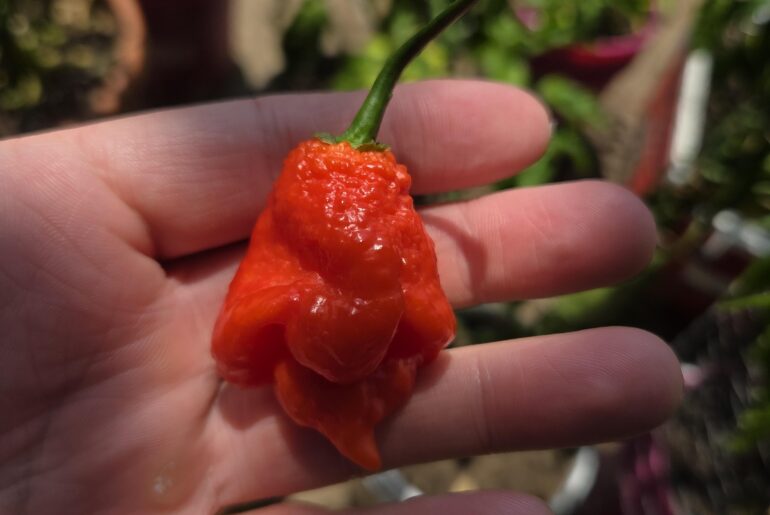
Chili pepper names tell you everything you need to know: Dragon’s Breath, Carolina Reaper, Naga Viper. These peppers are bred to be as spicy as possible by bumping up the concentration of capsaicin and capsaicinoids, the molecules that produce the burning feeling some diners crave—and others fear. Researchers have now found three molecules in hot peppers that suppress those spicy sensations (J. Ag. Food Chem. 2025, DOI: 10.1021/acs.jafc.5c01448).
Using liquid chromatography/mass spectrometry (LC/MS) and statistical analysis, Devin G. Peterson and his colleagues at the Ohio State University identified almost 1,900 molecules related to pungency (the scientific term for spiciness) in 10 kinds of chili pepper. They then used taste tests to figure out which of these compounds were negatively correlated with pungency. In other words, the more of these molecules, the less spicy the peppers. The group previously used the method, which they call nontargeted LC/MS flavoromics, to study coffee flavors.
The analysis led them to three molecules: capsianoside I, roseoside, and gingerglycolipid A. Further taste testing confirmed that adding these compounds to a capsaicinoid solution made it taste less spicy.
Researchers identified three molecules in chili peppers that made spicy solutions of capsaicinoids less spicy to taste testers.
Peterson says scientists already knew these compounds are in chili peppers but weren’t aware of their effect on pungency. The three molecules play a number of roles in plants, including defense against insects, building cell walls, and regulating stress responses.
The researchers suspect the molecules interact with the TRPV1 receptor, which produces a sensation of burning pain when capsaicin binds to it. But more research would be needed to confirm this interaction, says Jie Zheng of the University of California, Davis, who studies the capsaicin-TRPV1 system and was not involved in the recent paper.
The discovery throws some cold water on a long-used measure of chili peppers’ spiciness, the Scoville heat unit (SHU). SHUs are calculated according to a pepper’s concentration of capsaicinoids, but the new research shows that spiciness is more complicated.
Peterson has a lot of ideas about how this new knowledge could be useful. For one, he thinks chili pepper growers could double some peppers’ potency if they bred these compounds out of new pepper varieties.
Or they could go the other way. Michael Mazourek, a Cornell University vegetable breeder, created a nonspicy habanero variant called a habanada in 2007. He now wonders: “Could someone like me modulate perception through selection of different ratios of these compounds to capsaicinoids?”
In addition, chili peppers contain high levels of nutrients, including vitamins A and C; Peterson suggests that reducing their spiciness could help people eat more of the nutritious peppers.
The compounds could also have medical uses. Capsaicinoids are used to treat pain essentially by overwhelming pain receptors. But that means patients initially feel the burning sensation capsaicinoids are known for. These molecules might be able to do a similar job without causing pain.
Chemical & Engineering News
ISSN 0009-2347
Copyright ©
2026 American Chemical Society